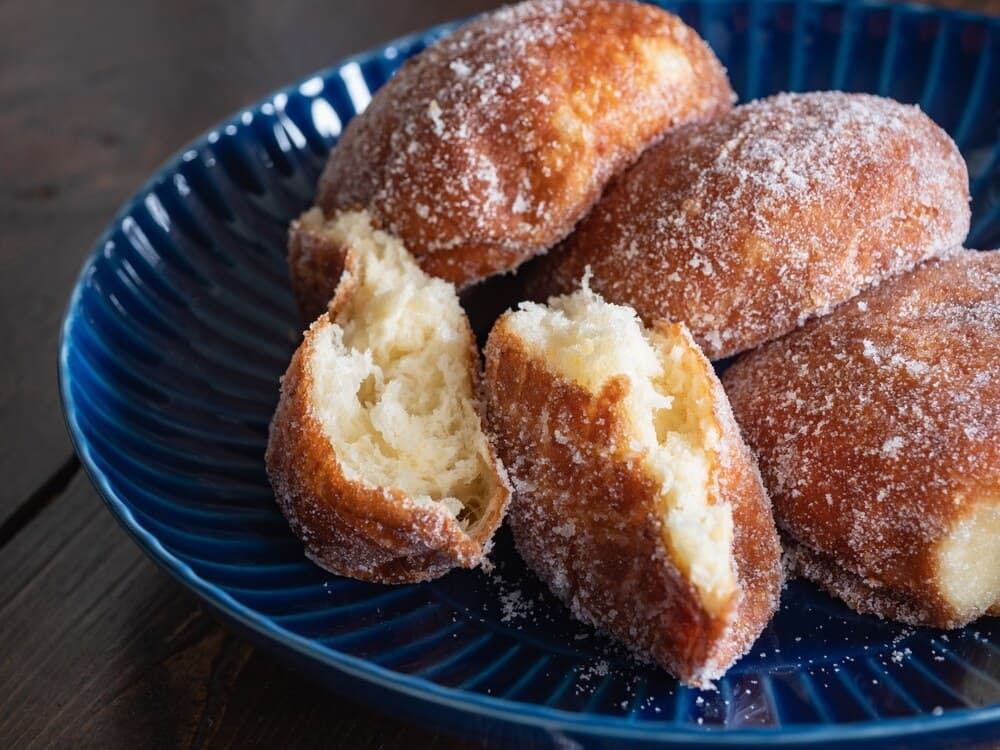
Malasada
 portuguese
Traditional Portuguese-origin doughnuts coated in sugar, made from a fried risen dough.
Main ingredients


Recipe
Ingredients
- 120 ml whole milk
- 5 g dry baker's yeast
- 345 g wheat flour
- 1.5 g salt
- 67 g sugar
- 2 egg(s)
- 15 g unsalted butter
- 60 ml heavy cream
- 1 tsp vanilla extract
- frying oil
Instructions
Preparing the dough:
- 1Slightly warm the whole milk (it should be lukewarm, not hot) and mix in the dry yeast.
- 2Let rest for 5 to 10 minutes until the mixture foams.
- 3In a large bowl, mix the flour, sugar, and salt.
- 4Beat the eggs and add the milk-yeast mixture.
- 5Then add the melted butter, the cream, then mix in the vanilla extract.
- 6Mix until you get an even mixture.
- 7Make a well in the center of the dry ingredients.
- 8Pour part of the liquid mixture into the well and mix with a wooden spoon.
- 9Add the rest of the liquid mixture little by little while mixing.
- 10Knead the dough until smooth and elastic (about 8 to 10 minutes).
- 11Cover the bowl with a clean cloth and let the dough rise in a warm place for 2 hours, until it doubles in size.
Shaping the malasadas and second rise:
- 12Gently punch down the dough.
- 13Flour the work surface and roll out the dough to a thickness of about 1 cm.
- 14Using a cookie cutter, cut out disks of dough.
- 15Arrange the malasadas on pieces of parchment paper on a baking sheet.
- 16Cover with a cloth and let rise for another 2 hours.
Cooking:
- 17Heat frying oil in a pot to 180°C.
- 18Place the malasadas in the hot oil using the parchment paper, and gently remove it.
- 19Cook the malasadas on both sides until nicely colored.
Coating:
- 20Let the malasadas cool slightly.
- 21Roll them, while still warm, in sugar to coat them.
About this dish
Malasadas are traditional doughnuts of Portuguese origin, particularly popular in Hawaii, where they were introduced by Portuguese immigrants. Unlike donuts, they have no hole in the center and are characterized by their soft, light texture. Made with a risen dough enriched with eggs, milk, and sometimes butter, they are fried until golden outside while staying tender inside. Traditionally, malasadas are coated in sugar, but modern versions include fillings such as pastry cream, chocolate, or jam. They are often eaten during celebrations like Mardi Gras, where they symbolize a treat before Lent. Tasty and comforting, malasadas are appreciated for their simplicity and rich flavor, making them an irresistible specialty for pastry lovers around the world.
Discover other dishes from cuisine portuguese
Ratings and reviews
No reviews yet — be the first to share your thoughts!