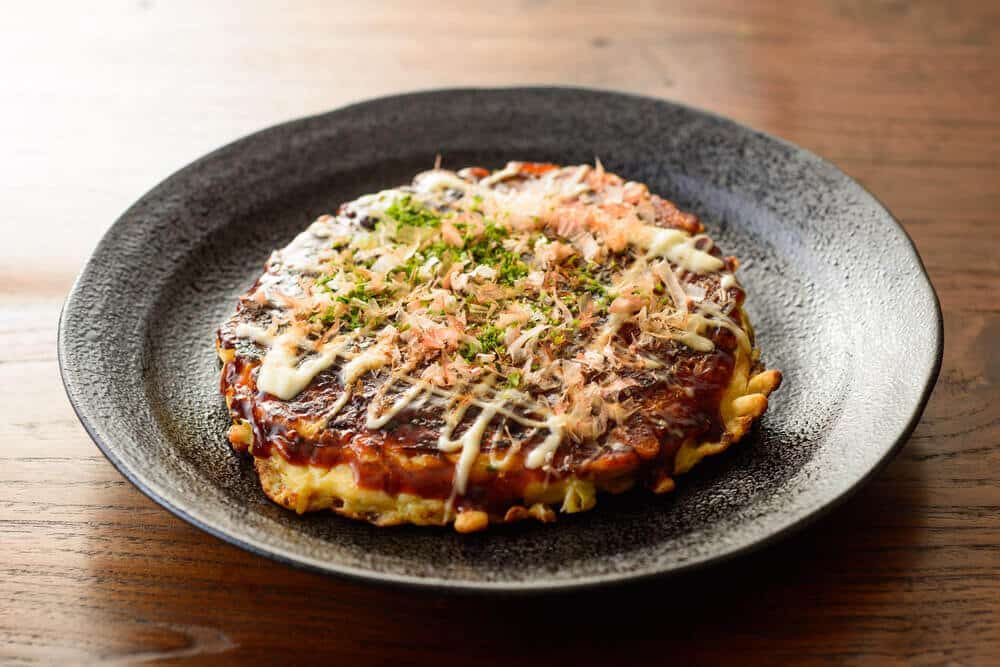
Okonomiyaki
 japanese
Thick Japanese pancake filled with cabbage and pork belly, topped with okonomiyaki sauce and katsuobushi.
Main ingredients


Recipe
Estimated total cost for 4 personnes: 10,58 € — average indicative prices
No reviews yet — be the first to share your thoughts!Ingredients
For the pancake batter:
- 250 g wheat flour
- 1 tbsp baking powder
- 80 g cornstarch
- 350 ml dashi
- 2 egg(s)
For the topping:
- 0.5 white cabbage
- 200 g pork belly
- 2 stalk(s) spring onion
- 2 tbsp beni shoga
- 100 ml okonomiyaki sauce
- 100 ml Japanese mayonnaise
- katsuobushi
- nori
Instructions
Preparing the ingredients:
- 1Cut the cabbage into thin strips and place it in a bowl.
- 2Finely chop the pickled ginger.
- 3Thinly slice the green part of the spring onions and cut the white part into thin rounds.
Preparing the pancake batter:
- 4In a large bowl, mix the flour, baking powder, and cornstarch.
- 5Add the eggs and dashi and whisk until the batter is smooth.
- 6Add the cabbage and the white part of the spring onions, then mix.
Cooking the okonomiyaki:
- 7Heat a non-stick pan over medium heat and oil it lightly.
- 8Sauté the pork belly slices.
- 9Pour the okonomiyaki batter over the pork belly and spread it evenly to form a circle about 2 cm thick.
- 10Cook for 4 to 5 minutes until the bottom is golden.
- 11Gently flip the okonomiyaki using a large spatula and a plate.
- 12Cook for another 4 to 5 minutes until the second side is golden.
Plating:
- 13Generously brush with okonomiyaki sauce and Japanese mayonnaise.
- 14Garnish with the green part of the spring onions, dried bonito flakes, and powdered nori.
- 15Serve immediately.
Tips for success
- Dashi tip: If you don't have homemade dashi on hand, instant dashi powder, diluted in hot water according to the package instructions, works very well. For example, a bonito broth base like this one: https://www.lemarchejaponais.fr/product/base-de-bouillon-a-la-bonite-40g/104425/
- For cooking: Cook over medium-low heat rather than medium-high. Okonomiyaki is thick (2 cm), so if it cooks too quickly on the outside, the inside stays raw. It's better to cook a bit longer and more gently.
About this dish
Okonomiyaki, often called "Japanese pancakes", is a culinary specialty originating from the Hiroshima and Osaka regions of Japan. The name "okonomiyaki" comes from "okonomi", meaning "what you like", and "yaki", meaning "grilled". These thick pancakes are made from a batter of flour, eggs, shredded cabbage, and various ingredients such as meat, seafood, or cheese. Once mixed, the ingredients are cooked on a griddle until the surface is crispy. Okonomiyaki are then topped with a thick, sweet-savory sauce similar to Worcestershire sauce, and often garnished with dried bonito flakes, Japanese mayonnaise, and seaweed. Depending on the region, preparation can vary — in Hiroshima, for example, the ingredients are layered. These pancakes, both filling and flavorful, are a staple of izakayas and street food stalls in Japan.
Discover other dishes from cuisine japanese




Ratings and reviews
No reviews yet — be the first to share your thoughts!